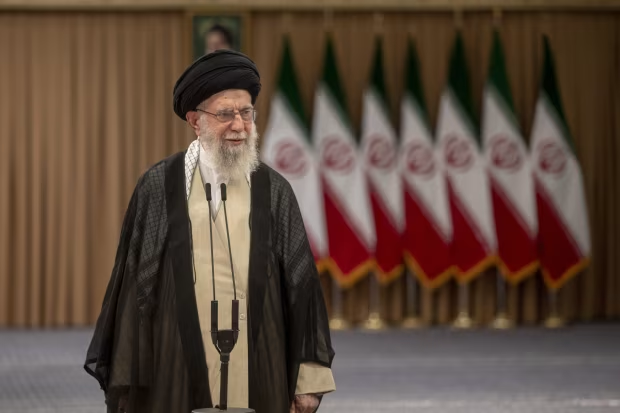
Ayatollah Ali Khamenei, Iran’s supreme leader since 1989 and the central figure in the Islamic Republic for more than three decades, was reportedly killed on February 28, 2026 during a large-scale joint U.S. and Israeli air campaign. Western officials and major news organizations say the 86-year-old leader died in strikes that hit his compound and other senior regime targets in Tehran, an event that has thrown Iran and the wider Middle East into sudden uncertainty.
According to U.S. and Israeli briefings, coordinated airstrikes struck leadership and military sites across Tehran in the early hours of the morning. Satellite imagery released afterward showed heavy damage and smoke rising from the supreme leader’s residential and office compound, which officials described as a primary target. President Donald Trump announced Khamenei’s death publicly and framed the operation as a decisive blow against a longstanding adversary. Israeli officials echoed the claim. Iranian state media initially avoided confirming the reports, creating several hours of ambiguity, but later in the day the White House stated that Khamenei had been killed, and major international outlets began publishing obituaries and retrospective analyses.
Khamenei had ruled Iran longer than any leader in the modern Middle East. Born in 1939 in Mashhad, he trained in traditional Shiite seminaries and became active in opposition to Shah Mohammad Reza Pahlavi in the 1960s and 1970s. After the 1979 Islamic Revolution, he rose quickly through the new system, serving in senior posts and surviving a 1981 assassination attempt that left his right arm permanently damaged. Later that year, following the bombing that killed President Mohammad Ali Rajai, he became president and served two terms during the Iran–Iraq War. When Ayatollah Ruhollah Khomeini died in 1989, constitutional requirements were revised to allow Khamenei, then a mid-ranking cleric, to become supreme leader. Though some questioned his religious credentials at the time, he moved swiftly to consolidate power through alliances with hardline networks and, crucially, the Islamic Revolutionary Guard Corps.
Over the next 36 years, Khamenei reshaped the Islamic Republic into a more centralized and security-driven system. While elections continued, real authority rested with unelected institutions loyal to him, including the Guardian Council and the IRGC. Presidents came and went, but major decisions on defense, foreign policy, and internal security flowed from his office. Waves of protest, from the 2009 Green Movement to the 2019 fuel demonstrations and the nationwide unrest following Mahsa Amini’s death in 2022, were met with force. Under his leadership, what many analysts described as a deep state took firmer shape, a network of military, intelligence, and economic institutions closely tied to the supreme leader’s authority.
In foreign policy, Khamenei consistently cast the United States and Israel as existential adversaries and supported regional allies such as Hezbollah and Hamas as part of what Iranian officials called the axis of resistance. At the same time, he showed tactical flexibility when he believed regime survival required it, most notably by allowing the 2015 nuclear agreement to proceed despite public skepticism of Washington’s intentions. His approach blended ideological confrontation with careful calibration designed to avoid a direct conventional war that could threaten the system itself.
By the mid-2020s, Iran was facing intense economic pressure from sanctions, inflation, and recurring unrest. Israeli and American strikes in 2025 targeted nuclear and military infrastructure, reportedly prompting tighter security around Khamenei and limiting his public appearances. Tensions escalated again in early 2026 amid regional instability and renewed confrontation. The February 28 offensive was presented in Washington and Jerusalem not only as a response to security threats but as an effort to disrupt Iran’s leadership at its highest level.
His death sets in motion only the second succession process in the Islamic Republic’s history. Under the constitution, the Assembly of Experts selects the next supreme leader, while an interim council temporarily assumes his powers. Yet the reported deaths of other senior officials in the same strikes may complicate that transition, and some analysts believe the IRGC could assert a more direct political role if the clerical establishment appears weakened.
The killing of a sitting supreme leader in a foreign military operation marks a dramatic escalation in tensions between Iran, the United States, and Israel. It raises the risk of retaliation and wider conflict even as Iranian authorities work to maintain domestic control. At the same time, some opposition figures view the moment as a potential turning point. Whether the outcome is increased military dominance, a negotiated political transition, or prolonged instability will depend on how Iran’s political, clerical, and security factions navigate the vacuum left by the man who dominated the country for nearly four decades.
Khamenei’s legacy remains contested. Supporters argue that he preserved Iran’s sovereignty, resisted foreign pressure, and expanded its regional influence despite sanctions and war. Critics contend that he deepened the country’s isolation, suppressed dissent, and entrenched a system that left little room for meaningful political reform. His reported death in a foreign airstrike underscores how closely his rule was tied to the long confrontation between the Islamic Republic, its own citizens, and its adversaries abroad.